


Sustainable Environment
Lead-Free Mono-Material Printed Packaging, Local Ingredient Sourcing, Wastewater Management, and Waste Reduction
Environmental Policy
In response to environmental challenges such as climate change and resource depletion, companies must pursue business growth while also taking responsibility for environmental protection. HANTECH BIO-TECH pioneered the retort pouch manufacturing process, breaking through the limitations of traditional bottles and containers and leading source-level carbon reduction through lightweight, low-carbon design. From energy conservation and carbon reduction to resource management and pollution prevention, HANTECH systematically promotes environmentally friendly initiatives. As the company’s manufacturing processes are highly dependent on water resources, water resource management has become a core focus of environmental management. HANTECH BIO-TECH has adopted multiple risk management and adaptation measures. In addition to continuously improving water-use efficiency, the company also addresses climate-related water risks, including:
1. Regularly assess the potential impacts of climate risks and opportunities on operations and financial performance.
2. Conduct a comprehensive review of facility conditions and water resource use, and develop corresponding measures:
◣ Strengthen flood risk management mechanisms.
◣ Optimize inventory and material preparation management strategies.
◣ Strengthen supply chain forecasting and risk diversification mechanisms.
◣ Strengthen water conservation, reuse, and flexible allocation measures to reduce water shortage risks.
Greenhouse Gas Inventory
To effectively promote greenhouse gas inventory management, the company has established a top-down sustainability information management structure. In addition to the Board of Directors serving as the highest governance body, the Sustainable Development Committee has been established under the Board (see the Sustainable Development Committee Charter for details). The ESG Sustainable Development Task Force has also been established under the Chairman and consists of relevant functional units. The task force is responsible for coordinating the human, technical, financial, and facility resources required for greenhouse gas inventory activities to ensure compliance with ISO 14064-1:2018.
To advance low-carbon transformation, although disclosure is not currently mandatory by regulation, the company has proactively conducted Scope 1 and Scope 2 inventories in accordance with ISO 14064-1 to comprehensively understand energy use and carbon emissions, establish a foundation for low-carbon management, and create a practical basis for sustainability and climate action.
(1) Energy and Emissions Overview
• Total energy consumption in 2024 was 14,695.38 GJ, mainly from purchased electricity (41.81%) and natural gas, followed by liquefied petroleum gas, with relatively limited use of diesel and gasoline.
• Energy intensity: 19.635 GJ per NTD million in revenue.
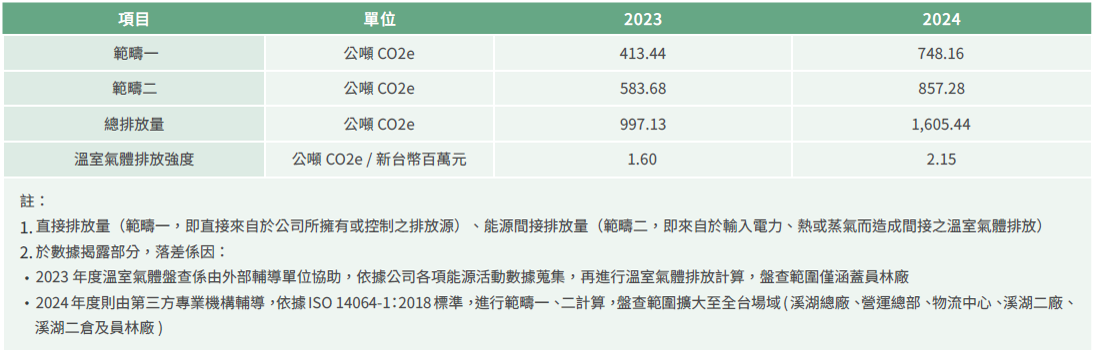
• Scope 1 emissions: 748.16 tCO2e; Scope 2 emissions: 857.28 tCO2e; total carbon emissions: 1,605.44 tCO2e. These data provide a precise basis for subsequent carbon reduction actions.
(2) Reduction Practices
• Natural gas use efficiency improved by 8-10%, reducing energy costs.
• Power system efficiency improved by 4-5%, achieving electricity-saving targets, reducing environmental impact, and strengthening energy management on the production side.
(3) Future Outlook
• The company plans to complete installation of the solar energy system by Q1 2026 to increase the proportion of renewable electricity used.
• Continue reducing overall electricity consumption to achieve source-level carbon reduction and green transformation.
Energy Management and Green Energy
To improve energy-use efficiency and reduce environmental impact, the company follows the ISO 50001 energy management standard and has established energy management guidelines to promote the sustainable use of global resources and strengthen the company’s sustainable operating capabilities. In terms of green energy development, solar panel installation is expected to be completed in Q1 2026. By reducing rooftop temperatures and introducing renewable energy, the company aims to further increase the use of green electricity and reduce overall electricity consumption.
Since August 2024, HANTECH BIO-TECH has progressively implemented multiple energy conservation and carbon reduction measures, including water conservation, reduced gas use, recovery and reuse of RO concentrate water, filter installation, and other emission reduction initiatives. The company has also upgraded and optimized refrigeration equipment to improve cold chain system efficiency and stability, reduce energy losses, and support stable operations. To further improve energy-use efficiency, the company plans to add energy-saving equipment and adjust system voltage to reduce equipment failure rates and extend service life.
Looking ahead, HANTECH BIO-TECH will continue improving energy management and actively respond to climate change challenges. Through systematic management and independent energy-saving initiatives, the company will steadily advance carbon reduction and sustainable operations.
At the same time, the company will establish due diligence and early-warning reporting mechanisms and incorporate energy and climate issues into daily operational decision-making, steadily advancing toward low-carbon transformation and sustainable development.
Annual energy consumption: 14,695.38 GJ; carbon emissions: 1,605.44 tCO2e. Energy-saving actions:
(1) Internal Energy-Saving Measures (since August 2024)
• Introduce the recovery and reuse of sterilization hot water to reduce boiler natural gas and gas consumption, effectively improve energy efficiency, and reduce carbon emissions.
• Install filters and balance electrical loads to reduce energy loss.
• Upgrade refrigeration equipment to improve cold chain efficiency and achieve more efficient energy use.
(2) Production Process Optimization
• After improvements to specific production lines, production efficiency increased by 50-60%.
• Boiler steam consumption decreased significantly, achieving both energy savings and improved production capacity.
• Annual energy consumption and carbon emissions were effectively controlled.
(3) Fuel System Conversion
• The Yuanlin Plant converted from liquefied petroleum gas to natural gas.
• At the same production volume, natural gas consumption decreased by approximately 7.5%, reducing energy expenses and carbon emissions.
(4) Mid-Term Infrastructure Plan
• More than NTD 3 million will be invested to upgrade water, electricity, and natural gas infrastructure.
• Improve energy efficiency and operational resilience while strengthening low-carbon, high-efficiency production capabilities.
(5) Future Outlook
• Continue monitoring equipment performance and dynamically adjust operating strategies.
• Advance production systems toward high efficiency, low carbon, and sustainable development, creating long-term impact for energy management and net-zero goals.
Water Resource Management
HANTECH BIO-TECH has incorporated water resource management into the Board-level sustainability governance framework and established comprehensive water-use policies and management systems to improve water-use efficiency and operational resilience while reducing the environmental impact of water waste. For water conservation, intelligent monitoring and recycling systems have been introduced, reducing water use by 10-15%, equivalent to approximately 120 GJ of water savings, while strengthening operational resilience, easing pressure on local water resources, and expanding positive impacts on the community.
(1) Results
• In 2024, water withdrawal was 159.38 thousand cubic meters, water consumption was 0.91 thousand cubic meters, and water discharge was 158.47 thousand cubic meters, demonstrating a high water recycling rate and low water consumption.
• Annual water use was reduced by 10-15%, equivalent to approximately 120 GJ of water savings.
• Daily Management: Promote water-saving actions by shutting off unnecessary water sources and recovering non-process water. High-efficiency water-saving equipment is also used to significantly improve resource utilization. Improvements to noise and water leakage also contribute to stronger community relations.
• Recovery and Reuse:
1. Introduce intelligent monitoring and analysis in major water-use areas to enable more scientific and precise management.
2. Recover process wastewater for reuse in specific processes, including air-conditioning cooling and daily cleaning, to reduce water waste while ensuring discharge complies with environmental regulations.
• Water Shortage Prevention and Response: Conduct daily inspections and report abnormalities immediately; establish a water leakage SOP; add 5-ton water storage capacity; implement warning measures and prompt repairs; and incorporate structural issues into long-term improvement plans.
(2) Future Outlook
• Continue improving water-use efficiency and reduce the impact of non-process water waste on the environment and operations.
• Expand water recovery and reuse by planning rainwater harvesting and fire protection reserve water to build a resilient water resource system.
• Strengthen monitoring and flexible response mechanisms to ensure stable operations under extreme climate conditions and protect both production and environmental benefits.
Waste Management
(1) Implementation Measures
• Follow the Waste Management Procedures to ensure that waste classification, temporary storage, and disposal are conducted legally and effectively.
• Total waste generated in 2024 was 96.27 metric tons, corresponding to total production of 130,310 thousand pouches, with waste intensity reduced to 0.00074 metric tons per thousand pouches.
• Recycled materials accounted for 54.08%, while recyclable/reusable/compostable packaging materials accounted for 12.98%.
• Fully implement an electronic approval system to promote paper reduction and improve resource-use efficiency.
(2) Future Outlook
• Continue improving waste resource recovery and recycling rates.
• Strengthen monitoring and management processes to ensure environmental compliance and sustainable performance.
• Advance the circular economy to maximize waste reduction and reuse.